Usage
Take this medicine as directed by your doctor or pharmacist. Check with your doctor or pharmacist if you are not sure. Adults and children 6 years and older: 1 spray in each nostril up to 3 times a day. Not for longer than 7 days.

10,35 KM
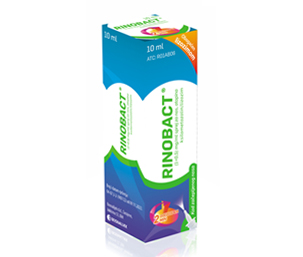
RINOBACT (1+0.5) mg/ml nasal spray contains two active substances xylometazoline and lysozyme.
Xylometazoline works by narrowing the small blood vessels in the nasal mucosa (vasoconstrictive property) and thus reduces the swelling of the mucosa (decongestive effect). Lysozyme is a natural ingredient present in body secretions such as mucus, tears, saliva. Lysozyme has the properties of moisturizing and protecting the nasal mucosa. In addition, it also works in the nasal cavity by accelerating the movements and stimulating the activity of epithelial cilia (cilia), which helps to clean the nasal cavity of accumulated secretions, allergens and infectious substances. With its action, lysozyme contributes to the effectiveness of xylometazoline.
RINOBACT (1+0.5) mg/ml nasal spray is used:
To reduce swelling and protect the nasal mucosa in colds (viral rhinitis);
To reduce swelling and irritation of the nasal mucosa in vasomotor rhinitis (runny nose due to occasional dilation of blood vessels) and allergic rhinitis;
To facilitate the discharge of nasal secretions in inflammation of the paranasal sinuses, as well as catarrhal inflammation of the middle ear associated with colds.
Take this medicine as directed by your doctor or pharmacist. Check with your doctor or pharmacist if you are not sure. Adults and children 6 years and older: 1 spray in each nostril up to 3 times a day. Not for longer than 7 days.
One ml of nasal spray, solution contains: xylometazoline hydrochloride 1 mg; lysozyme hydrochloride 0.5 mg (corresponding to 20,000 FIP units).
One dose of spray (0.14 ml of nasal spray, solution) contains 0.140 mg of xylometazoline hydrochloride and 0.070 mg of lysozyme hydrochloride.
Excipients with known effects: propylene glycol, methyl parahydroxybenzoate (E218) and propyl parahydroxybenzoate (E216).